Thursday, January 12, 2012

Tebow Has All the Tools...but One


Here at FreeTime, we like to kick them when they're up and lift them when they're down. This is partly because we're pathologically obsessed with The Overrated and The Underrated*, and partly because debate is sort of like Olympic diving - degree of difficulty matters.

* In fact, when I was coming up with a name for this blog, one idea was Overrated/Underrated, with every story focused on someone/thing that was overrated (Jeter! Clooney!) or underrated (John Adams! Eli Manning!). Notice how the Underrated guys need their full name spelled out?

Which brings us to the matter of Tim Tebow. I had a Tebow column halfway written on December 11, after the Broncos defeated the Bears. Tebow was riding high: the Broncos had won 7 of 8, his passing yards had increased 5 straight games, his TD-to-INT ratio was 8-1, and his critics were cowering in the corner. It was time to strike.

But alas, on December 12th I was diagnosed with a detached retina, and two days later had surgery. While I was recovering Tebow fell hard. The Broncos got crushed by the Patriots, trampled by the Bills, and in week 17, an important game against the Chiefs to guarantee a playoff spot, Tebow put up the following line:

6 for 22, 60 yards, 0 touchdowns, 1 interception.

The Broncos scored 3 points and needed the Raiders to lose in order to backdoor the playoffs. I don't care how much you mistrust stats: that is some seriously crappy, unclutch, non-winning football. And as anyone who saw the game will attest, it wasn't just a statistical nightmare; it was an avert-your-eyes horror show.

So the moment had passed. I couldn't pile on then.

But now Timmy's back! He had his best game as a pro Sunday. It had the usual Tebow dramatics but with a twist: big passing numbers! He even broke John Elway's Broncos' record for playoff yards. So, it's time for me to enter the fray.

Now let me stipulate a few things first:

1. I like Tim Tebow. He seems like a genuinely good guy in a sports world filled with bad guys.
2. I like the Tebow story. It is like every sports movie every made - the underdog who is told he can't do it but pulls it off in dramatic fashion.
3. I especially liked the fact that Tebow beat Ben Roethlisberger, who is, let's say, not a good guy.

Finally, he has many qualities that are useful in an NFL quarterback. Useful, but not necessary. For example:
  1. He is big and strong, which is useful but not necessary (see Drew Brees).
  2. He is very good at running the ball, which is useful but not necessary (see Peyton Manning)
  3. He is fiery and animated, which is useful but not necessary (see Eli Manning).
  4. He had great success in college, which is useful but not necessary (see Tom Brady).
  5. He is a morally upright person, which is useful but not necessary (see Ben Roethlisberger).

Those five quarterbacks won 8 of the last 10 Super Bowls. All but the injured Peyton made the playoffs this year, as usual. And while all of them are different, they share one thing in common: they are really really good at throwing a football.

And that's my problem with the Tebow Debate. It's become, like most sports arguments, a litmus test on Stats vs. Winning*.

* And unlike most sports arguments, a litmus test on religion. But I'm not going there. For that, I recommend this piece by Fran Tarkenton in today's Wall Street Journal.

But all of this ignores the most important question: Can a quarterback have long-term success iin today's NFL if he can't throw well? And Tim Tebow cannot throw well:
  • His YPA (yards per attempt) is 6.4, 29th in the league behind, well, pretty much everyone but Curtis Painter. YPA is arguably the single most important passing stat.
  • His completion % is 46.5%, 34th among the 34 QBs who threw enough passes to qualify. He is the only QB in the league under 50%.
  • TD % is 4.4 (meaning, he throws TDs on 4.4% of his passes). Not bad, at 13th in the league, but still beyond such stalwarts as Christian Ponder, Mark Sanchez, and Matt Moore
  • His INT% is solid. At 2.2 he is 9th in the league.
  • But that is offset by his QB rating. At 29th, he is behind Colt McCoy, among other mediocrities. QB rating measures efficiency and loves a low INT %. But the rest of Tebow's game is so horrendous, the paucity of picks doesn't help much.
  • His Yards Per Game is 34th. The only starter in the league who is lower is Josh Freeman.

And finally, there is Game Winning Drives*. Ah, the fans say, what do you have to say now, Smart Guy? He's tied for the league lead with 6, which is impressive. But there are two problems with that. One is that a guy like Aaron Rodgers has only one - not because he can't do it, but because he's so damn good all day long he generally spends his final drive taking a knee.

* Definition: An offensive scoring drive in the 4th quarter or OT that puts a team ahead for the last time.

But the other is this: do you know who has been better than Tim Tebow at game winning drives? Go ahead, I'll give you a minute. No, it's not Eli Manning, who also has 6 but was the starter in more games. It's not Alex Smith, with 5, though he was good, too. Drew Brees? Good guess, but he only had 4.

No, the best comeback quarterback in football this year was John Skelton. Casual fans don't even know who he is, but football fans know he took over the Cardinals' starting job in November. He played in 8 games for the Cards this year, starting 7 - and had 5 game-winning comebacks. 5 comebacks in 8 games? That's amazing...but something tells me he won't be on the cover of Madden next year.


Finally, the last worrisome thing for those who picture a Tebow plaque at Canton someday...

Tim Tebow isn't playing in the 60's, 70's, 80's, 90's, or even the first decade of this century. He's playing at time when explosive passing attacks have taken over the sport. You've seen all the stats elsewhere, but this paragraph by Gregg Easterbrook captures well what a passing league the NFL is right now:

It's the year of offensive stat-a-rama throughout the NFL. There have been five 5,000-yard passing seasons in NFL history; three of them were this year. Drew Brees and Tom Brady both eclipsed the previous passing yards record in the same season. Records were set for passer rating, completion percentage and team yards from scrimmage. In the regular season, NFL teams averaged 235 gross passing yards per game, surpassing the previous high of 221 in 1995 and way above the 1971 average of 156 yards. Three of the top five rushing teams missed the playoffs while all the top five passing teams made the postseason. Detroit just gained a spectacular 882 yards passing in two games over six days -- and lost both because opponents gained 928 yards passing. The Packers and Patriots, with the league's lowest-rated defenses, just used scoreboard-spinning to win the conference top seeds. The league's No. 1 defense, the Pittsburgh Steelers, is already out of the playoffs, torched by Denver. In this year of offensive stat-a-rama, even a sputtering offense trumped the best defense!

I like Tim Tebow. It's a truly great sports story. And I'll be rooting for him this weekend against Patriots.

But enjoy the show now. This is the modern NFL, where a quarterback has to be able to consistently throw balls into very tight spots. And that is the one thing Tim Tebow cannot do.

Saturday, November 26, 2011

Timeless Truths

A few people have asked me why I haven't written about Penn State. They figured this topic was perfect for FreeTime.

I haven't written about Penn State because I have nothing original to say. In fact, I never have anything original to say about crimes of the moment. Natalee Holloway, Caylee Anthony, even O.J. Stories like these have played out millions of times in human history, and all the human foibles on display have been demonstrated by novelists, poets, playwrights, philosophers, theologians and (believe it or not) politicians for thousands of years. I can add nothing to them that hasn't already been said by Shakespeare or Plato or Jefferson.

So rather than add my two cents, I'll merely quote one of the greatest political philosophers, Edmund Burke: "All that is necessary for the triumph of evil is that good men do nothing."


Thursday, November 17, 2011

The No-Skip Songs (Part 3)

And finally, Part 3...(go here for Part 1 and Part 2)

But before I go on, since Part 2 was posted Mrs. Keatang has challenged the notion of this list.

"So it's a list of your favorite songs," she said.

"Not exactly," I replied. "Double Trouble isn't my favorite Lynyrd Skynyrd song. It's Gimme Three Steps or The Ballad of Curtis Loew or live Freebird. They are all better songs."

"So, then, it's a list of your favorite songs right now."

"Well, no," I stammered, "these are songs I don't skip."

"You don't skip them because you're sick of those other songs, so these really are your favorite songs."

"Um, not exactly..."

"So you're saying, you skip songs you prefer in order to listen to songs you don't like as much."

"That's not what I'm saying!"

"This list makes no sense," she concluded.

And I have to admit, she's probably right. On to Part 3!


Yellow Ledbetter, Pearl Jam, Jeremy [US]
This tune (which probably isn't as good as Black or Even Flow or Alive) fits into two interesting categories: great songs that never made it onto an album (it's an outtake from Ten), and songs that sound meaningful and profound even though you have no idea what the vocalist* is saying.

* Speaking of Mrs. Keatang, Eddie Vedder is on her Top Five To Do list (a list that shrank with the passing of Heath Ledger). I'd feel jealous but as I said in Part 1 I don't experience jealousy.  Plus, I admire her good taste.

Anyway, I've purposely avoided looking up the lyrics for this song because, as an old college friend said about R.E.M. back in 1985, "I like them because you can make up your own lyrics."

How Blue Can You Get?, B.B. King, Live in Cook County Jail
If you were to create the perfect blues song, you might start with a guitar intro that prowls and pounces like a tiger. Mix in a vocal performance packed with pathos and bravado. Sprinkle in a wicked sense of humor. And of course it would have to be live, ideally in a prison yard.

B.B. packs all of that into this masterpiece.

Mr. Bojangles, The Nitty Gritty Dirt Band, Uncle Charlie and His Dog Teddy
Pop music is great at evoking feeling, but terrible at creating characters. How much do we really know about Angie, Barbara Ann, and Sweet Caroline - indeed, every woman who has had a pop song named for her? They are ciphers who exist merely to explain how they make the narrator feel.

Mr. Bojangles is as quirky as any of the menagerie that passes through a Bob Dylan song, but as fully realized a character as you're going to find in a four minute song. And this cover by The Nitty Gritty Dirt Band gets me every time.

Levon, Elton John, Madman Across the Water
If pop music is bad at character, it really sucks at plot. Which is understandable, given space limitations.

In this song, it's as if Bernie Taupin said to himself, hmm, I wonder how much of a sprawling family saga I can pack into a few verses. We learn a surprising amount about three generations of Tostigs.

But that's not why I love this song. I love it for the same reason Levon calls his child Jesus: because I like the sound of it.

Landslide, Dixie Chicks, Home
This Fleetwood Mac cover is the first song in Part 3 I'm a little embarrassed about.

First of all, I have no actual Fleetwood Mac songs on this list, and I love Fleetwood Mac, or at least I love the album Rumours. So how did this cover of a non-Rumours song get on here, but no actual Mac recordings?

Second, my favorite Mac* songs are the Lindsey Buckingham tunes, not the Stevie Nicks ones, so how did a cover of a Stevie Nicks song get on here?

* Is there a more curiously named band than Fleetwood Mac? For any song, one of three people - Buckingham, Nicks, or Christie McVie - is the frontman of the band, singing a song of their own composition. So naturally the band is named after the other two guys.

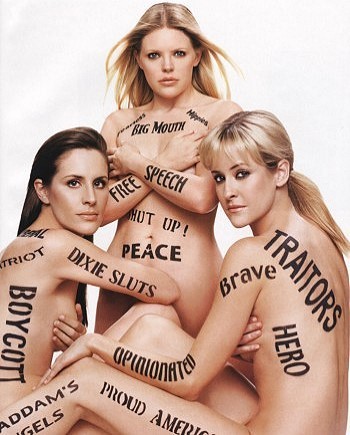
Third, while I think anyone - including dopey actors, singers and other celebrities - can make any kind of political statement wherever and whenever they want, it irritates the hell out of me when they act like martyrs because some people are pissed off about it. In Soviet Russia, when you spoke truth to power you got sent to the Gulag Archipelago; in America you get put on the cover of Rolling Stone with no clothes and treated like an (anti) war hero.

And finally, I couldn't tell you a single other Dixie Chicks songs.

Still, I don't skip this song, and it makes me wonder why I don't actively seek out more country music with great harmonizing. I was kind of blown away by Lady Antebellum's National Anthem during the Jets-Cowboys 9/11 game. Maybe I should get a record from them...

Hey Hey What Can I Do, Led Zeppelin, B-side of Immigrant Song
Like Yellow Ledbetter, this song was deemed unworthy of inclusion on an album. But it made the FreeTime No Skip list!

As I wrote in Part 2 (or was it Part 1? I've dragged this thing on for months...) I don't have much use for The Who or Led Zeppelin anymore. But then this song doesn't contain most of the things that people associate with Zep; there is no pounding Bonham drums, no Page guitar solos, no references to Lord of the Rings.

It's just a lovely little ditty about the perils of loving a drunken slut.

Finnegan's Wake, Tommy Makem & the Clancy Brothers, Irish Drinking Songs
This song has everything for me: nostalgia (my parents used to sing it in the car); a literary heritage (James Joyce based his novel of the same name on this Dublin street ballad); a raucous sense of humor (it's about an Irish wake with, as Tommy Makem says in this live introduction to the song, "dancing, drinking, fighting, everything"); and some great Irish slang (Shilellegh law, welt the floor). Oh, and it's just a blast to listen to.

The Boy in the Bubble, Paul Simon, Graceland
If I compiled a list of songs I wish I'd written, this would certainly be on it.

Simon has always been the most exquisite of lyricists; you'd never catch him trying to rhyme "Texas" with "facts is". This is not always a plus, as sometimes sloppiness can be a good thing in music. But this song is a lyrical gem.

1952 Vincent Black Lightning, Richard Thompson, Rumour & Sigh
I'm not the sort of person who laments the fact that our culture celebrates trash, while some of our greatest artists labor in obscurity. It makes sense that James Patterson sells more novels than Jonathan Franzen. Kids should prefer Spongebob to Stravinsky.

But the obscurity of Thompson is, if not a crime, a cultural misdemeanor. His guitar playing alone should have put him among rock royalty, and songs like this should be played on the Memorial Day 500 Best Songs of All Time marathons.

Any number of Thompson tunes could be on here but this one about a boy, a girl, and a motorcycle, gets the nod.

St. Dominic's Preview, Van Morrison, St. Dominic's Preview
Despite what I said earlier about Tom Petty, Van Morrison would be my desert-island artist. I don't think there's a performer with a greater mix of lyrical and vocal virtuosity, nor one who travels across genres as effortlessly as Van Morrison. Mrs. Keatang turned me on to this song years ago, and it has remained a favorite, though I can't quite state why. It's an impressionistic song with a lot of imagery adding up to....well, I'm not quite sure. (In fact, more than any other song I've ever googled for lyrics, there is little agreement on some of the lines.)

But Van infuses the vocal performance with such meaning that I end up singing along to such lyrics as "Safeway supermarkets in the rain" and "Edith Piaf's soul" as if I know what he means, when in fact I have no idea.

Hallelujah, Rufus Wainwright, Shrek soundtrack
There are a surprising amount of covers on this list. And there have been some embarrassing songs on this list. So what better way to wrap it up than a song from kids movie soundtrack that has become the most over-covered song on the planet?

Written by Leonard Cohen, over 200 versions of this song have been recorded, and it's nearly been destroyed by its overuse in movies and television. But this version by Wainwright, to a simple piano arrangement, is nearly a perfect song.

***

That's it, the FreeTime No-Skip Song list. If the artists on my iPod could actually talk, I'm sure there'd be bitching and moaning. I can almost picture Bob Dylan's shocked disgust ("Landslide? The Dixie Chicks' Landslide?"). Gregg Allman is mournfully playing the organ. Eddie Van Halen is whaling on his guitar, trying to capture my attention. Tom Waits is lighting a cigarette, telling me to fock off. Wilco's thinking, hey, I thought we had a good thing going. R.E.M. and U2 think the whole thing is a farce.

Hey hey, what can I say?


Friday, October 14, 2011

Mann Down


The Latest Twist in Manning-Brady Rivalry

Quarterbacks, more than any other athlete performing any other task, rely on their teammates.

Up to half a dozen man-mountains block for them. Freakishly large-handed speed demons catch the passes thrown by them. QBs hand the ball off to quick and powerful men who run for them - which helps make it easier for them to throw. They are guided by a team of brilliant workaholics who come up with detailed and intricate plans, who literally write books about what quarterbacks should do.

I'm not saying quarterback is an easy job. In fact, it's arguably the hardest job in the world to excel at. Think about it: at any given point in time, there's only about 15 people on the planet who are doing a good job as an NFL quarterback. Are there more than 15 good neurosurgeons in the world? Does the 16th best particle physicist on the planet perform at a higher level than Joe Flacco? Could you find twenty to thirty outstanding nuclear submarine captains in a pinch?* The answer to all of these questions is yes.

* There are several hundred nuclear submarines in the world. I'm thinking the 16th best captain is pretty damn good.

The challenge is separating a quarterback's greatness from all those other factors. What if, for example, Joe Montana was drafted two picks earlier in the 1979 draft, by the Tampa Bay Buccaneers? Instead of the brilliant Bill Walsh, he would've inherited John McKay as head coach. His premiere wide receiver in the 80's would have been Kevin House rather than Jerry Rice. The average defensive rank of his team from 1980-1989 would have been 20th rather than 7th*. And he would've had to wear those ridiculous orange uniforms.

* The Niner defense was genuinely great in the 80's, not merely a nice complement to a great offense. Their rank in Points Allowed from 1981 to 1989 was: 2, 23, 4, 1, 2, 3, 3, 8, 3.

What kind of career would Joe Montana have had if he'd been picked by the Bucs? I should add that I did not choose the Buccaneers by random. I chose them because in the mid-80's Steve Young spent a couple of seasons as the Tampa quarterback. It did not go well. He won 3 games, threw twice as many interceptions as touchdown passes, completed 52% of his passes, and looked ridiculous in that orange uniform.

In 1992, however, he replaced Joe Montana and had five brilliant seasons, one of the great runs in quarterback history. He got behind the wheel of that 49er sports car and drove it faster than Montana.

All of these variables - head coach, receiving corps, defense, running game - make it therefore very difficult to truly judge the value of a quarterback, and nearly impossible to conduct something close to a controlled experiment.

But something very close to that is being performed in Indianapolis right now.

Painting a Picture

A while back, I made the case that Tom Brady-Peyton Manning was the best "Who's Better?" debate in sports history. My argument went like this:

From 2001-2006 Brady-Manning followed the usual script of great player debates. Like Wilt-Russell, Marino-Montana, and ARod-Jeter, one player put up the monster stats and one player put on the rings.

But in 2006-2007, the players reversed roles. In 2006 Manning became Brady. The Colts beat the Patriots multiple times, including a thrilling comeback victory in the 06 AFC Championship game. The Colts went on to win the Super Bowl and Manning was crowned Super Bowl MVP.

More shockingly, in 2007 Brady became Manning. A guy who had been an efficient 3500 yards/25 TD guy suddenly went off for 4800 yards and 50 TDs. After missing all of 2008, Brady has continued as a brilliant quarterback, an elite passer in the NFL. (And to complete his transformation into early 2000s Manning, he stopped winning Super Bowls.)

A handful of rings and elite passing statistics? It's never been done before. Add in the fact that Manning plays in a dome and Brady in the New England winter? As a longtime Manning supporter, I was forced to admit that Brady just might be the better quarterback.

But here's where we come to our controlled experiment. In 2008 Tom Brady got hurt in Week 1 and lost the season. A kid named Matt Cassel, who literally had not started a game at quarterback since he was in high school, got under center. (In fact, he is the only QB in league history to start an NFL game having never started one in college).

How'd he do? The Patriots went 11-5 and had the 5th ranked offense in the NFL. Cassel threw for 3700 yards and 21 TDs with a 63% completion rate. Not bad, huh?

This year, Peyton Manning is out for the season. Curtis Painter is under center for the Indianapolis Colts. Painter has a much more impressive resume than Cassel had. As a sophomore at Purdue, he set the Big 10 passing record. He broke a bunch of Drew Brees' records at Purdue, and would have broken more if not for an injury Senior year.

Painter hasn't been terrible. He's only thrown one interception, and his completion rate and QB rating are both very respectable. He's actually 3rd in the league in Net Yards per Pass Attempt, behind Brady and Rogers.

But the Colts are ranked 31st in total offense, 27th in points scored. And they're 0-6. Since Manning's second season, the Colts have won 10 games or more every year but one*. This year, they've already lost 6.

* That one was 2001 when they went 6-10. It wasn't Manning's fault - the Colts had the #2 offense in the league in 2001. But as has often been the case in Manning's career, he had a bad defense. Colts were ranked 31st in Points Allowed in 2001. The average rank of Colt D since 1998 is 16th in the league. In 2006, Manning won the Super Bowl with a defense ranked 23rd.

Remove Brady from the Patriots' offense and it slows down. Remove Manning from the Colts' offense and it comes skidding to a halt.

It's another interesting twist in the greatest individual "Who's Better?" debate ever.


Sunday, September 11, 2011

The Sun Fled

Another Remembrance of September 11

9/11/11
I'm not sure you've heard, but the tenth anniversary of September 11th is today.

Well, of course, you've heard. Every magazine has cover stories on it. Sporting events from the U.S. Open to our local rec soccer league are honoring the day. Radio stations are going DJ-free for the weekend. And of course, the politicians will wrap themselves in flags and blow long-winded speeches and get misty-eyed all day.

I feel a little guilty about this, but I find it a bit maudlin at best and exploitative at worst. The maudlin exploitation will reach its heights tonight when two of my least favorite football teams, the Cowboys and Jets, play the first New York football game of the season. The NFL, masters of patriotic flair, will make the event seem more American than the signing of the Declaration of Independence.

So I was reluctant to add my voice to the rivers of rhetoric flowing this weekend. But I actually was in Manhattan that day, as I've been in Manhattan most of my working days for 23 years. And I thought, before I forget, I should record my memories of that day, and the weeks after.

9/11/01
In September of 2011, I was working at a publishing company on 21st Street, near the Flatiron Building. But Tuesday the 11th found me farther uptown, on Park in the 30's, at an offsite meeting.

As I walked into an unfamiliar office building on Park Avenue, my first contact with the news came like many others. The front desk guys had just heard reports that a plane hit one of the Twin Towers. We assumed it was a small plane, assumed it was an accident, and went up to our meeting.

But by mid-morning our mobile phones were buzzing and we knew it was bigger. My friends from work and I found a conference room with a television and started watching. Like everyone else, we watched the towers fall...over and over and over. The repetition should have been numbing, but it wasn't - each time it had the same shock value.

After an hour we left for a pub, Rosie O'Grady's, on 46th Street and 7th Avenue. Why a pub? Partly because my bro-in-law the Rock Star was there and partly because we felt trapped and isolated in this unfamiliar office building and wanted to be among other people.

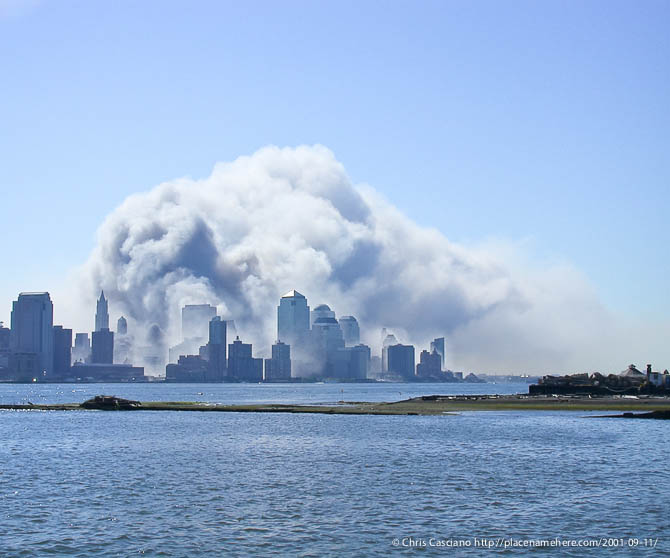
As we came out into the street on Park Avenue the scene stunned us. The city was effectively shut down - no cars were moving, police were everywhere. Pedestrians roamed the street. I looked left - downtown - and was further stunned by the volume of smoke rising from lower Manhattan. I was a good 3 miles North of the Trade Center but the vast haze of smoke seemed much closer.

At this point, we go into a bit of an information void. The bar was packed and loud and it was impossible to hear the television. Plus, mobile service in the city was sketchy at this point, further cutting off communication with the outside world. We were so close to Ground Zero we could see it but knew less of what was happening than someone watching Tom Brokaw on their couch in Tacoma.

I had two close friends working downtown in those days. One, Gombo*, we found quickly - he never made it past the Lincoln Tunnel on his way to work. The other took much longer to find - he was among the crowds who walked home across the Brooklyn Bridge.

* Gombo had a lot of associates who worked in the Towers and made an observation few have made since then. The NFL season opened the night before, with a Monday night game between the Broncos and the defending NFC champs Giants. The game was close late - it was tied mid-way through the 3rd quarter - which meant that many Giants fans were up much later the night before than they normally would be on a Monday night. Which meant they got a later train the next day. Which meant when the planes hit the towers at 8:46am and 9:03am, a lot of guys who normally have been at their desks at the time were still making their way to work.

Rumors were that the bridges and tunnels were shut down but we decided to hop in the Rock Star's car and head home. There was surprisingly little traffic on the West Side highway, but many of the cars were covered with soot. We got up to the George Washington Bridge and - this part's a little strange - we crossed right over. Strange because everyone we've talked to since said the bridges and tunnels were closed all day.

The most spectacular view of the Manhattan skyline are from New Jersey. As we headed South on the eastern spur of the New Jersey Turnpike, lower Manhattan was on our left. I've lived in the New York area my entire life and know the skyline well. But here was lower Manhattan, denuded of its most familiar landmarks, and in their place a vast cyclone of smoke rising up and drifting right out the island tip and over the Statue of Liberty. Our car was silent.

Eventually I got home to my wife and family. My kids were 4 and 1 and had no idea what happened. My wife and I hugged for a long while, and watched TV till the early morning hours.

The worrying wasn't over, though. My father, at the time a 61 year-old volunteer firefighter, joined the armies of volunteers headed downtown to help. He spent the evening at Shea Stadium, mobilized with so many others hoping to help. But of course, he never made it to Ground Zero. There was nobody left to save.

After 9/11
I stayed home on the 12th and returned to the city on Thursday the 13th. My office was on 21st and 5th and the smoke was still clearly seen from our corner, and would be for weeks to come. The presiding mood in the city was paranoia. That day I had a box with a poster in it, and walking the streets I felt people looking at the box, wondering what kind of weapon I had in there.

I was fortunate to not lose anyone close in the attacks, but in the coming months it was astonishing how many deaths we heard about. The owner of our local pizzeria lost his wife. A buddy from our pick-up hoops game's aunt was killed. My cousin Kevin, FDNY, lost many friends, including his closest. Another firefighter, Danny Marshall*, who went to elementary school with my wife, died along with 11 others from his firehouse.

* The story of that house, Engine 40, Ladder 5, is told in David Halberstam's book, Firehouse. My wife still has the ornament Danny gave her for Secret Santa 35 years ago, and it goes on our tree every year.

Amazingly, the ripples continue. We've only recently learned that one of my daughter's classmates lost his father that day. His mother was pregnant at the time, and the baby girl born months later is on the cover of People this week.

In the weeks after 9/11 everything was different. I've been an avid reader my whole life, but couldn't read fiction. I read nothing but histories of the Middle East and newspapers and magazines. I couldn't listen to music for weeks, maybe months.

One day in late September I tried to venture downtown with a couple of work friends. We couldn't get close enough to Ground Zero to see much, but instead spent an extraordinarily poignant hour in Union Square Park. USP is on 14th Street, and in the aftermath of 9-11 14th Street was a barrier to downtown - you couldn't go South. Therefore, the park became an impromptu gathering place.

There is an equestrian statue of George Washington in the park, his sword seemingly pointing towards the Trade Center. It was covered in flowers and peaceful graffiti. All around the park signs for Missing People were posted, but what had started as signs had become memorials, with flowers, tributes, and street art. We walked through like it was a large communal wake, reading every tribute, knowing by now these people weren't missing and mourning their deaths.

Things returned to normal, eventually. For me, the symbolic end of the mourning period came with my return to music and fiction. I was in the library looking at novels when I saw a book called A Winter's Tale, by Mark Helprin*. I picked it up and read in the front flap that it took place in a mystical version of New York City, near the turn of the 20th Century. Hmm, I thought, that might work for me. New York, but not New York. In the table of contents I saw a chapter titled "White Dog of Afghanistan". That seemed fitting. Finally, I read in the author bio that the author's next book would be called Giuliani: A Soldier of the Great War. That cinched it - I took the book out of the library and lost myself in its pages.

* I became a big fan of Helprin's and consider him the most underated American novelist of my lifetime. The critical acclaim of his earlier works is over-the-top and well-deserved. True fame has eluded him so far, but maybe one day his genius will be recognized.

Finally, there was music. I was driving in my car listening to a CD my friend Jimmy Shin made for me when a Greg Brown song came on called Funky Day. The opening verses suddenly had new meaning for me:

Well the coffee boiled and the sun fled
Ah there's grime on the windows, and the streets are dead
It been Tuesday all week and it's Tuesday again
Today is a Parisian, I am an American.

And I know it ain't, I know I ain't, I hope you ain't
Gonna go away
Ah will ya help me help me help me help me help me help me make it through this funky day
Ah will ya help me help me help me help me baby will ya help me
Ya gotta help me make it through this funky day.


We'd all lived through months of Tuesdays, reliving the moment when the sun fled and the streets were dead. Life returned to normal for those of us lucky enough not to have lost loved ones.

Yes, the commemoration of today may be a bit maudlin and exploitive, but you know, sometimes the bumper stickers are right: We shall never forget.


Tuesday, August 16, 2011

I Got Thome

The other day, the great Joe Posnanski* wrote a piece about how in sports we don't need a reason to choose what we celebrate, we just need a consensus. In other words, if we all agree that hitting streaks are worth celebrating, we celebrate them. But if we all agree that 10,000 rebounds, a feat achieved by 34 men, isn't such a big deal, we don't celebrate them.

* When I do these little asterisk/italics things, I am using a Posnanski invention called the Posterisk. It is superior to parenthesis and footnotes, and I hope it catches on.

As it turns out, his timing was perfect. Because last night Jim Thome hit his 599th and 600th home runs. It was an astonishingly rare achievement, one of the rarest in sports. Only 8 men in baseball history have accomplished the feat, and the other 7 are baseball legends, admitted steroid users, or both.

And yet...the world yawned. There will be no HBO special commemorating his chase for 600. His achievement did not pass the Lucille Test. Few people marveled at the way he achieved it, being the first man to hit back-to-back jacks to get to a six-pack.

Most importantly, ESPN's SportsCenter this morning followed up the highlight of this game with a segment titled "Hall of Famer?" The report, by Tim Kurkjian, concluded he was a Hall of Famer. But that's quite a question mark. 600 homers does not punch your ticket to the Hall.

This is in stark contrast to the celebration around Derek Jeter's 3,000th hit. 3,000 hits is a much more common achievement. 28 guys have gotten to that level.*

* In a related note, sometime this September Clinton Portis will become the 26th NFL player to rush for 10,000 yards. Will anyone care?

In fact one can argue Thome has been a better player than Jeter. He's almost certainly a better hitter. He got to his 600th homer with far fewer (around 900) plate appearances than Jeter needed for 3000. He has a lower batting average (.312 to .277), but a higher On-Base Percentage (.403 to .383) and a much higher slugging % (.557 to .449).

Of course, Jeter was a far superior fielder and a much better base runner (335 stolen bases to 19). The Captain was not quite the October superhero people think he was, but he was a very good post-season player, whereas Thome wasn't. Most importantly, Jeter is the rare modern athlete who has spent his entire career with one team, so his connection to that fan base is greater, certainly, than Thome is to Minnesota, or even Cleveland.

The point here isn't to bash Jeter, who deserves the credit he received. It's to wonder why Thome's far rarer achievement is virtually ignored.

It's not because he's a bad guy - in fact by all accounts he's a great guy. According to Joe Pos, he's won the Clemente Award and the Gehrig Award. He's been voted the nicest guy in baseball by his peers. And it has something to do with the fact that homers have been devalued in our post-Bonds era.

But still...there's a good chance that in about 8 or 9 years, Jeter will be cruising to Cooperstown as a first-ballot Hall of Famer. And Jim Thome might be on his 3rd year trying to get in. Will he be joining him?

Note:
About the name of this post...in 1992 my friends and I founded the Madisox Fantasy Baseball League. (Odd Couple fans know the name comes from an episode involving television's greatest sportswriter). That first year, well, the details are hazy but my buddy Costello drafted this Indians prospect named Jim Thome. Later, somebody tried to draft Thome but Costello, looking over his roster, said, "No, I got Thome. I definitely got Thome." Only he pronounced it with a Th- sound, rhyming with home. Anyway, "I got Thome" is one of the catchphrases of our league, and has been repeated at every draft since.

Saturday, July 23, 2011

The No-Skip Songs (Part 2)


In Part 1 of the No-Skip Songs, I discussed how technology has changed the way we listen to music. As we've evolved from LPs to CDs to Walkmans to MP3 players, our ability to skip songs has multiplied. And now, in my mid-40's, I hit the Skip button on my iPod a lot. Either technology or age has made me a fidgety, impatient listener.

The No-Skip songs are tunes that consistently hold my attention, and I'm often surprised at which ones. Some I knew as a teen, but didn't consider a favorite then. Some are by artists I barely know. Some of my favorite artists are not represented (close friends will be shocked by the absence of Bob Dylan). But for whatever reasons, right now, these are (some of) my No Skip Songs.

Why 21 songs? My original No Skip playlist was 45 songs. But I cut it down to 21 - specifically to 80 MB - so that it would perfectly form a CD mix. Here we go, in no particular order:

Solsbury Hill [live], Peter Gabriel, Plays Live
There's a handful of songs on this list that I may have liked as a teen, but I get as an adult. We reach crossroads in our life, moments of confusion, and there's nothing purer than the moment of clarity when suddenly we know the right direction. May eagles fly into all our hilltop reveries and show us the way home.

I think that's why Solsbury Hill works better as a live song. Great singers are actors, too, and you can hear the yearning in Gabriel's vocals. He's going home.

Hey Jealousy, Gin Blossoms, New Miserable Experience
Seriously, I have no idea how this song got here. I couldn't name another Gin Blossoms song and have never owned a Gin Blossoms album.

As for the feeling of jealousy, it is completely alien to me. I like it when other guys check out my wife. Damn right, she's with me. Give me Hamlet and Macbeth over Othello any day. But what can I tell you - this song comes on, I ain't skipping.

Redemption Song (live in Pittsburgh), Bob Marley, Songs of Freedom
Recorded shortly before his death, this live version gets me before it even starts. There's a little guitar intro, a joyous shout from Bob, and then, "Yes, this little song is called old pirates, you know, redemption song".

Knowing his body is already racked with the cancer that will get him soon makes the hopeful vocals more poignant.

Tumbling Dice, The Rolling Stones, Exile on Main St.
The Stones in general hold up for me. I have no use for The Who anymore and little use for Zeppelin, or most of the big classic rock bands of my youth. There will always be a place in my heart for them but they are almost always skipped.

But a bunch of Stones song pass the Skip Test. Angie, Gimme Shelter, Can't You Hear Me Knocking. On a larger No-Skip list, they'd be well-represented. In fact, Dice only only edged Knocking on this list because it's shorter, and fit in my 80 MB.

Cry Love, John Hiatt, Walk On
Twenty years ago, an acquaintance made me a mix that changed my listening habits. On one tape I was introduced to Graham Parker, A Tribe Called Quest, and a host of other songs and artists I didn't know.

One of those guys was John Hiatt, and this song provided the ultimate "Who is this guy?" moment. I've since dug deeper into Hiatt, but this remains my favorite.

Thunder Road, Bruce Springsteen, Live 1975-1985
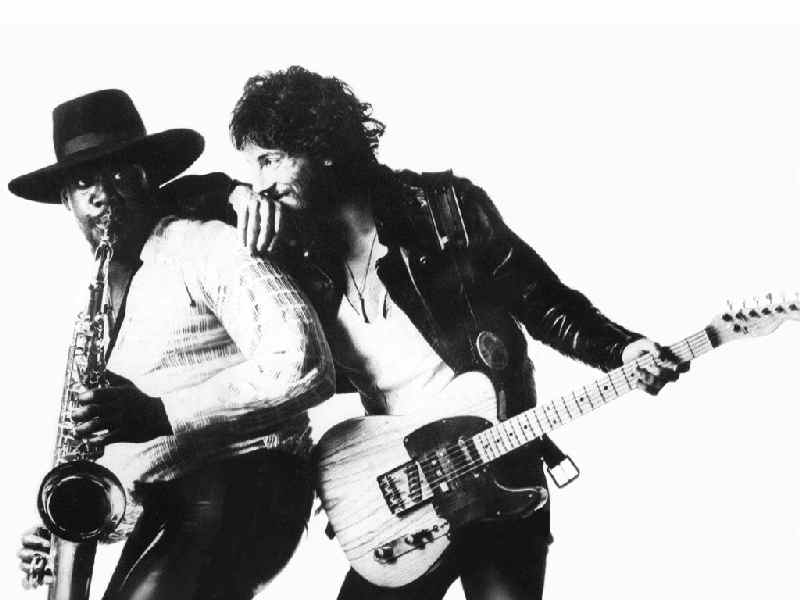
The only song on this list to crack the Top 100 on Rolling Stone Magazine's list of Top 500 Songs of All Time (#86). The album Born to Run has the famous cover shot of a guitar-slung Boss and a sax-blowing Big Man. But this live version from The Boss's 1975 shows at The Bottom Line in New York is a reminder that Springsteen's classic 1975 record was drenched in piano. I wonder if E Street keyboardist Roy Bittan, who was equally spectacular on Dire Straits' Making Movies, is annoyed at that album cover.

Double Trouble, Lynyrd Skynyrd, Gimme Back My Bullets
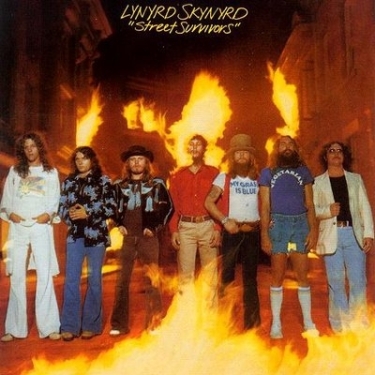
If you have any interest in the depths of my teen obsession with Skynyrd, click here. Suffice to say, I was a hard-core fan. I knew every song on every album, knew the band lineup changes, had the original Street Survivors LP (real fans know what I'm talking about)

But if you asked me in 1981 to name my favorite Skynyrd songs, I'm not sure this would have made the Top 10. In fact, the Bullets album in general spent the least time on my roundtable. But for some reason now, when I hear that great opening guitar intro, I'm hooked.

What'd I Say, Pt. 1 & 2,Ray Charles, Rhino Hi-Five
I think my introduction to Ray Charles was through the Columbia House record club. You old folks remember - 13 albums for a penny. Back before Napster changed everything, the closest you can get to music piracy was joining, quitting, and re-joining Columbia House. And with so many albums to choose from, I'd start picking some old guys with whom I was only vaguely familiar.

Well, Ray Charles' Greatest Hits blew me away. Unchain My Heart became a staple on all my mixes. But somehow I missed this song until the movie Ray, and it assumed an immediate place on my No-Skip list. It's still there.

Even the Losers, Tom Petty & the Heartbreakers, Damn the Torpedoes
If you ask me who my favorite artist is, I'd probably say Bob Dylan or Van Morrison. Favorite band? The Beatles. But if push came to shove - if I was really being placed on the metaphorical desert island and can only choose the collected works of one artist, I just may choose Tom Petty and the Heartbreakers.

Oh, I know, he doesn't have the street grandeur of the Boss or the ragged poetry of Dylan or the lyric mysticism of Van or the revolutionary inventiveness of the Beatles. But damn it, he has a million No Skip songs. I could've chosen any of a dozen, but threw this one on there because hey, even the losers get lucky sometimes.

Rhymes and Reasons, John Denver, Greatest Hits
That's right, John Denver. You got a problem with that? Seriously, put on this song, think about 9/11, and try to skip it.

And Your Bird Can Sing, The Beatles, Revolver
I know what you're thinking. Hey Jude. Let It Be. A Day in the Life. Yesterday. How the heck did this fairly obscure middle-period song get on the No-Skip list?

I'm not sure exactly. But try this on for size: in August 1965, the Beatles released Help! Four months later they released Rubber Soul. And nine months after that, Revolver. 12 months, 3 classic albums. Oh, and ten months after that, Sgt. Pepper's Lonely Hearts Club Band, often considered the greatest rock album ever made.

Compare that to U2, the undisputed rock kings of the 80's. It took them 7 years to release 4 albums (Unforgettable Fire, Joshua Tree, Rattle & Hum and Achtung Baby). Or Bruce Springsteen, who spent 8 years on Born to Run, Darkness, The River and Nebraska.

Of course, greatness isn't measured in number of albums. But the Beatles' albums had 12 - 14 songs on each one, and little gems like Bird are scattered throughout. For some reason, this song represents for me the most extraordinary creative burst of my lifetime, musical or otherwise. Or maybe it's just a cool ditty.


Okay, that's enough for now. Part 3 with ten more songs will be out in less time than it takes an 80s rock star to produce a masterpiece.

Monday, July 11, 2011

Congratulations, Mr. Jeter

I have to admit that even I, a card-carrying Yankee hater and full-fledged member of the "Jeter is Overrated Club", got a kick out of that 5-for-5, dinger for 3k, game-winning RBI performance on Saturday.

It's true that if Michael Kay said "the Captain" one more time, with that mix of teen-girl breathlessness and religious awe that one associates with lunatic cult members, I would have thrown my beer at the television screen.

But at the end of the day, I am a) a reader and writer who loves a great story, and that was an amazing story, and b) a baseball fan who revels in the statistical oddities of the sport. And the idea that Derek Jeter, who had hit a homer in precisely 1 of the previous 132 Yankee games (including post-season) would homer for his 3000th hit, is a statistical oddity of the highest order. Toss in 4 other hits and a game-winning RBI, and you have one of the most improbable days in baseball history. What baseball fan wouldn't love that?

(You buying any of this?)

Anyway, in honor of 3000, I'm linking to my piece entitled Chasing Tris Speaker, in which I make some attempt to estimate Jeter's career hit totals, and explain how important they are to his legacy. The short version is this: Jeter needs 516 hits to catch and pass Speaker, which would put him in the Top 5 all time. That's 171 hits over 3 full seasons, meaning he'd need to stay healthy and reasonably productive through his current contract, and get at least one more season in the bigs.


Wednesday, June 22, 2011

The No-Skip Songs (Part 1)


[This started out as an intro to a list of favorite songs. But the intro grew into a post of its own, so now it's Part 1 of a 3-part piece.]

Music listening has gone through 5 technology phases, sometimes overlapping:

1) Live music (400,000 BC - today)
2) Vinyl records (early 1900s - 1980's)
3) Walkman/Cassettes (1960's - 1980's)
4) Compact Discs (1980's - 2000's)
5) MP3 players (2003-today)

This is a simplification, of course. I skipped 8-track players because, well, they were 8-track players. I've ignored the role of radio and its evolution from AM to FM to satellite to internet. And I'm just winging it on the 400,000 BC thing, on the assumption some early homo sapiens banged some rocks together and liked how it sounded.

My point is this: as a 45 year-old who first got into music in the late-70's, I'm at the perfect age to have experienced every phase of music listening.

I've gone to many concerts, from my first (The Marshall Tucker Band, Nassau Coliseum, October 1981) to my most recent (Eddie Vedder, The Beacon, 3 nights ago).

As a 13-year-old I bought Pink Floyd's The Wall*, tore the shrink-wrap off the LP, put on Disc 1-Side 1-Track 1 (In the Flesh) and listened to the whole album, song by song. I read the liner notes, followed along with the lyrics, and agreed with Rogers Waters that I didn't need no education.

Throughout the 80's I made mixtapes, an arduous process that I took very seriously. I plotted the list of songs, the segues, the length - and then kept two fingers on the record button while I gently laid the needle onto the right song. I named the mixes, and carefully wrote the songs on the case. My college roommates would marvel that I managed my mixtapes with such precision, but couldn't be bothered to pair my socks after (finally) doing laundry.

I'd listen to these tapes over and over, usually on my Walkman. To this day, when I hear the end of REM's Pretty Persuasion, I expect it to be followed by America's Sister Golden Hair Surprise, and that to be followed by the opening drums of Train in Vain by The Clash. Because that's the order they appeared on my very popular Random Hour Mix*.

* This was before I started coining clever names for mixes, such as "Both Kinds" for a country mix. Get it?

And then CDs came. My college housemate, OD, had one of the first CD players on campus, and a modest collection. This was exciting stuff - if for no other reason than it made the making of mixtapes much easier. But the other reason was sound. I know there's this core group of audiophiles who think vinyl is superior, but not my vinyl. My soon-to-be-retired record collection in the late 80's was scratchy, dusty, and sounded like sand in a tuna can.

And now, finally, we get to the real point of this post. In addition to the superior sound, the CD player offered superior navigation. Suddenly, I found myself skipping songs. It was so easy - one button and I can skip right past a song I didn't like. No fast-forwarding, no needle-dropping - two presses, and voila - I can skip directly from Only the Losers to Don't Do Me Like That, without having to listen to Shadow of a Doubt and Century City or having to flip the record. CD players not only changed the sound of the music, it changed the songs I chose to listen to.

And now, of course, we're in the MP3 era. I'm a bit of an iPod junkie. I listen while walking my dog, emptying the dishwasher, waiting on a subway platform. I listen on line at the DMV, while walking to lunch, I listen when spreading mulch in my garden.

I have playlists for all occasions and all musical genres. And of course, I have thousands and thousands of songs.

But here's the thing: even though they are my playlists, my songs - all carefully curated - I still skip songs all the time. Even though Shadow of a Doubt and Century City aren't on the iPod, I still find myself skipping Don't Do Me Like That. (But not Even the Losers; that's a No-Skip song).

All of which is a very long-winded way of saying: here is a list of No-Skip songs. These are the songs that, at this stage of my listening life, I rarely skip. They are not the best songs of all time; they aren't even necessarily my favorite songs. But they are, right now, my favorite No-Skip songs.

But you'll have to wait for Part 2 for that...


Click here for Part 2 of The No Skip Songs


Thursday, May 26, 2011

There Goes Robert E. Lee

An Obscure Lyric Debate, Resolved

So I went to the Rock & Roll Hall of Fame in Cleveland recently.

There is much to quibble with about the Hall. The layout of the galleries is uninspired and doesn’t live up to the promise of I.M. Pei’s architecture. Favorite acts of mine (and I assume anyone who visits) are short-changed or ignored (Van Morrison, Lynyrd Skynyrd, Tom Petty). And unless you’re a guitar buff, once you’ve seen the first few dozen guitars, they all begin to look alike.

But there is some incredibly cool stuff. John Lennon’s Sgt. Pepper outfit, and his handwritten lyrics for “In My Life”. A letter from Pete Townsend circa 1975, talking about this new kid Eddie Van Halen (“He plays very fast, and what a grin. With a grin like that you don’t need taste”). And Mick Jagger’s tongue-in-cheek permission to Jann Wenner, allowing him to name his new magazine Rolling Stone, in return for favorable press coverage in the years to come.

Bottom line: if you’re in Cleveland, love rock & roll, and have appropriately low expectations, you’ll enjoy it.

But my purpose here is not to do a museum review. My purpose is to share with you the resolution of an incredibly arcane, but meaningful to me, lyric debate. A few years back, I wrote a blog post about how rarely and poorly rock & roll lyrics invoke history, and made a friendly swipe at The Band.

Specifically, I wrote:

Think of "The Night They Drove Old Dixie Down" by the Band. A great song (especially the live version) but historically inaccurate:

"Back with my wife in Tennessee,
When one day she called to me,
'Virgil, quick, come and see, there goes Robert E. Lee.'"

I thought, those silly Canadians, Robert E. Lee wasn’t in Tennessee during the Civil War.

Several readers wrote in to correct me, and I carried on a correspondence with one of them afterwards. Virgil isn’t claiming to see Robert E. Lee, they informed me, but the Robert E. Lee, a steamship that worked the Mississippi immediately after the war.

Internet research on the subject was inconclusive, with differing accounts. A close listen to the song is equally inconclusively, as Levon Helm appears to sing “there goes a Robert E. Lee”. That vowel between goes and Robert could be singer’s shorthand for the, or just a bridge sound.

Well, the Rock & Roll Hall of Fame in Cleveland, Ohio, has the answer. Robbie Robertson’s handwritten lyrics are there, and it quite plainly says:

There goes Robert E. Lee

Robbie Robertson, who wrote the song, beautifully evokes the closing days of the Civil War. And he deserves points for surely being the only rock and roller to mention Union cavalry General George Stoneman. But he wasn't talking about a boat.

His character, Virgil Caine, claimed to see Robert E. Lee, the General himself, in the state of Tennessee. And that is simply not possible.


* Hey, I did warn you this post was about an obscure dispute, didn’t I? I was with a colleague from work when I saw the lyrics, and excitedly explained the implications to him. He was smiling at me like I was a lunatic, and trying to convey to the other museum-goers he wasn't with me...

Saturday, April 16, 2011

Forgetting History

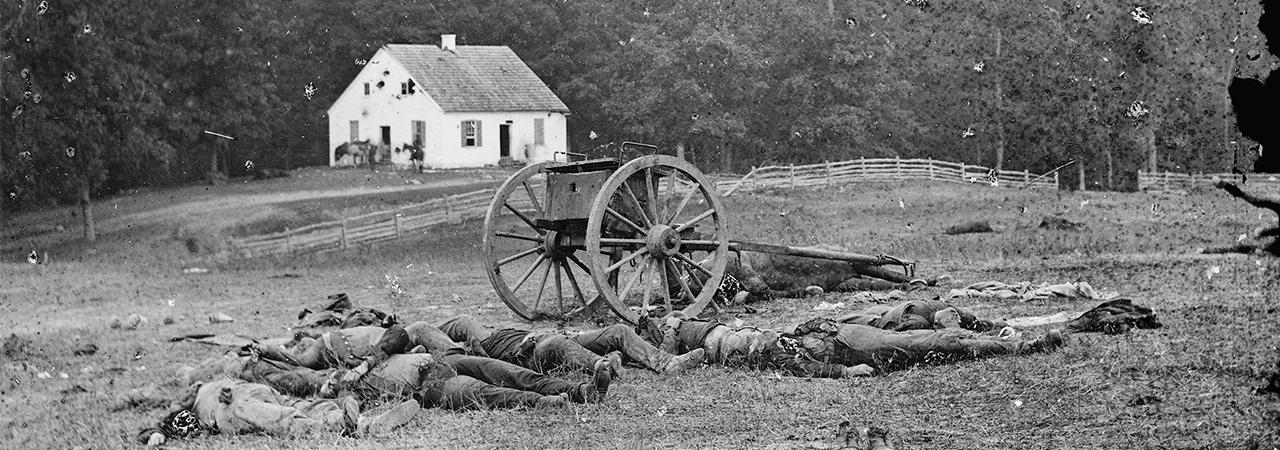
Dunker Church, Battle of Antietam, 1862

150 years ago this week, General P.G.T. Beauregard of the newly formed Confederate States of America gave orders to fire on Fort Sumpter, starting the Civil War.

I don’t consider myself a Civil War ‘buff’, but I am a student of the war. What’s the difference between a buff and a student? A student knows that the 20th Maine under the command of Colonel Joshua Chamberlain held the left flank on Little Round Top at Gettysburg.  A buff knows what weapons they carried, how many rounds they shot, what Confederate regiment they faced, and what Union regiment was on their right.

I’d add that buffs are interested mostly in the military aspects of the war. I am keenly interested in the military history of the war, particularly the major battles and commanders, but am as keenly interested in the political history.

From the debates over slavery in the Constitutional Convention through the vicious Congressional battles in the early 19th century; from the Mexican War through the Abolitionist movement; from the rise of Lincoln to the politics of Emancipation – it is the richest, most complex political story in American history. It is the story that gave birth to who we are today – the better and the darker angels of our nature - as much as the Declaration of Independence and the waves of immigration that followed the Civil War.

But I had a contrary thought this anniversary season. Maybe the remembrance of history isn’t all it’s cracked up to be.

A Long Memory
Americans are often, and justly, criticized for our lack of historical knowledge. One recent survey showed that more Americans knew that Michael Jackson was the composer of “Beat It” than knew that the Bill of Rights was a set of amendments to the Constitution. More than half the respondents to that same survey thought the War of 1812 or the Civil War occurred before the American Revolution.

* when I was in college, I read one of these articles about how ignorant American high school students are about their country. I refused to believe the results and began ambushing my sister’s friends, quizzing them. In one instance, I asked “Who is Walt Whitman?” One of her friends got all excited, saying “I know this one! I know this one! He built shopping malls!” (This is funnier if you know we lived near the Walt Whitman Mall.)

Naturally, our collective national ignorance bothers me. But then I remember who is really good at remembering.

The Irish, for example, have long memories. More Irish, I'm sure, could tell you who* won the Battle of Kinsale in 1602, than Americans could tell you who won Gettysburg.

* The bloody English, that’s who!

They have long memories in the Balkans as well. The Battle of Kosovo, fought in 1389, remains on the minds of many in the Balkans. In fact, Slobodan Milosevic, future war criminal, cited it in an important speech in his rise to power.

And then there is the Middle East. Ask an Arab who the Muslim hero of the Crusades is, and he could probably give you a brief lecture on the life of Saladin. Ask an American who the Christian hero of the Crusades is, and his best guess might be Robin Hood.

And finally, there are the descendants of the Confederacy. The Confederate States of America existed as a country for all of four years. It spent the entirety of those four years fighting a war it lost, a war fought for an ignoble cause, a war that devastated their lands, their economy, and their way of life. The decision of the Southern states to secede from the Union and fight a war that caused the deaths of 600,000 of their countrymen was, by any measure, a catastrophe.

And yet, 150 years later, Confederate flags fly. Confederate leaders are revered – Lee especially, but also Stuart and Stonewall and Forrest. Taken to its comic extreme, you'll occasionally see bumper stickers in the South that say "Hell No - We Ain't Forgettin'!"

And I mutter to myself, maybe you should. Maybe some historical amnesia wouldn’t be the worst thing. In the South, in the Balkans, in Ireland, and especially in the Middle East – it might be time to let the past go and think about the future.


Recommendations: If you don't plan on flying Confederate flags, but want to read one book about the Civil War, that book is James McPherson's Battle Cry of Freedom. On the internet you could do worse than spend some time at Disunion, the Civil War blog at the New York Times. Hat tip to Bamstutz.

Photo credit: The extraordinary photographs from the Battle of Antietam are usually credited to Matthew Brady, the famous Civil War photographer. They were in fact taken by Alexander Gardner, who was in Brady's employ. These photos were shocking to many Americans who were removed from the horror of war, and remain a landmark in the history of photography

Friday, April 8, 2011

A Nod to the Gods

The Appeal of Golf

All tastes are subjective.

If your tastes run to bluegrass, biographies, bratwurst, and brunettes, that’s what you like – and no amount of persuasion will change your preferences to rock and roll, romances, ratatouille, and redheads.

That’s why I never defend Bob Dylan. Many people hate Dylan’s music – or at least, don’t understand his appeal. They acknowledge his greatness as a songwriter, but can’t for a second grasp why any sane person with working eardrums would choose to listen his raspy warble.

I could make a reasoned case for Dylan. I can explain his revolutionary role in American music, play songs from Blood on the Tracks that don’t have the nasally twang of his bigger hits, explain the complex rhyming structure of a masterpiece like "Tangled Up in Blue". I can argue that singing isn’t just about a perfect voice, it’s about acting – and that Dylan’s singing gift is the ability to convey humor, anger, sadness, intelligence, sarcasm, even surrender. I can logically argue that if all we wanted in singing was a perfect voice, opera would rule the charts and rock and roll would only be played on the ass-end of the AM dial.

But if you don’t like listening to Dylan, I can’t persuade you with reason, logic, and facts that you should.

(This post started out as a post on golf, but I'm half-tempted to change gears here and talk about the role of criticism. For what is film, music, literary, or art criticism but the very attempt to persuade others with reason, logic and facts that they should like or not like something? Nah, let’s get back to golf.)

I bring all this up because I got in a conversation with someone recently who was opposed to golf. I mean, really opposed. Morally opposed and emotionally opposed and athletically opposed. He railed on about how it’s not a sport and it’s an expensive time-waster and that the world would be a better place if golfers would spend their time and money on more constructive pursuits.

What a moron.

Okay, that’s not fair; he’s entitled to the things he likes and doesn’t like. But I found myself, against my better judgment, making the case for golf. Or at least, making the case for why he should give it a shot. And I came up with two arguments:

The first, admittedly weaker, argument is that the great and powerful golf. Presidents golf, billionaires golf, movie stars golf. My point isn’t that we should imitate these people, God no. Or even that they are, in fact, great. My point is that these people have options. Barack Obama and Jack Nicholson can do pretty much what they want on weekends, but they mostly choose to golf. And, in the case of Obama and Nicholson, these are not people who grew up at country clubs; they came to golf later in life and fell in love with it. This should say something to the non-golfer. This should say, hmm, maybe I should give this a shot.

But the second, and more powerful argument, is that athletes golf. Michael Jordan has options, too. But more than that His Airness, perhaps more than anyone alive, knows what it is like to perform majestic athletic feats – to soar through the air with grace, ingenuity, and power. To outrun, out-jump, outwit, out-compete and out-everything the opponent. To hear thousands roar in ecstatic approval of his physical prowess.

Well, Michael Jordan spends the bulk of his free time golfing. And it is not just Michael Jordan – seemingly every baseball, hockey, soccer, football, basketball and tennis star on the planet are passionate golfers. Even those like Charles Barkley, who remains committed to this pursuit even though all available evidence suggests he should try an easier hobby, like nuclear fusion.

Why is that? What is the appeal of golf?

Everyone who loves the game already knows the answer to that question. But for those who don't, I'll turn to Ron Shelton, the writer/director of Tin Cup (and, not incidentally, a former minor league baseball player). In the following exchange Roy "Tin Cup" McAvoy (Kevin Costner) explains the golf swing to Molly Griswold (Rene Russo):


At another point in the film, Tin Cup offers a more direct explanation for the appeal of golf: “Sex and golf are the two things you can enjoy even if you're not good at them.”

I explained all this to the moron. Got nowhere. He probably likes Mariah Carey, celebrity self-help books, black licorice and pink Mohawks. There’s no accounting for bad taste.

Wednesday, March 30, 2011

What If?


There are three kinds of baseball teams.


There are teams like the Yankees, Red Sox, and Phillies that, barring catastrophe, are likely to win 90+ games.


There are teams like the Pirates, Mariners, and Diamondbacks that, barring a miracle, are likely to lose 90+ games.


Then there are the What If Teams. The What If teams are those that, if everything breaks right, something magical could happen. The San Francisco Giants were a What If team last year. They were 22-1 odds to win the World Series. Yeah, they had some young live arms, but their best hitter was Aubrey Huff – Aubrey Huff! They finished ten games behind the Dodgers and Rockies in 2009, a lot of ground to make up. The Giants needed a lot of things to break right for a magical season.


And they all did. The young pitchers delivered. They scored just enough runs, mostly at the right time. Minor league prospect Buster Posey came up in late May and hit 18 homers. The Dodgers and Rockies, both of whom won 90+ games in 2009, dropped to the low 80’s. And the Padres, oh the Padres, who were the Ultimate What If team all year, fell apart in September.


I bring this all up because the New York Mets are one of those What If teams.


If Everything Breaks Right

I won’t go into detail here (I did in this post), but look at the Mets’ Ifs.


- If the starting pitching does what it did last year (7th in team ERA; 19 shutouts);

- If K-Rod continues to punch out batters the way he did last year (before punching out his kids’ grandpop);

- If Wright, Reyes, and Bay play like the great offensive players they’ve been most of their careers;

- If young players like Ike Davis, Mike Pelfrey, and Jonathan Niese continue their growth;

- If you get some great performances from unexpected places (my vote is on Chris Young, who I took in the 23rd round of my fantasy draft Sunday night);

- If a new manager - one that doesn’t look like, sound, and manage like a Jazz bassist backing a beat poet in 1968 Greenwich Village basement cafe- can inspire this team

- If all these things happen, well...


But you don’t just need good internal things…it helps if bad things happen to other people. And the Phillies could be ripe for the sort of catastrophe that derails a promising team.


Would I like to have their rotation? Sure. But remember, the Big 3 are over 30, and candles in a birthday cake hit pitchers faster than hitters. And here's some Did You Knows...


Did you know Cliff Lee, before his great October, was 4-6 with a 3.98 ERA as a Ranger?

Did you know that in 2009 Roy Oswalt’s ERA was 4.12

Did you know Cole Hamels’ record the past two seasons is 22-22?

And did you know Roy Halladay’s given name is Harry Leroy Halladay? (I have nothing bad to say about his pitching. Guy is awesome.)


And that’s the pitching vulnerability. It’s on offense where they can have real problems.


Ryan Howard, Team Stud, took a significant step backwards last year. Instead of 45 HRs/140 RBIs he went 31/108. And while he played fewer games, his OPS also dropped, from .931 to .859. He is nowhere near the monster player he was in 2006and his comps on baseball-reference.com aren’t encouraging*.


* If you like baseball stats, one of the coolest features on baseball-reference is the comps – where you can compare players to other players in history.The player most like Ryan Howard, at the same age, in all of baseball history, is Richie Sexson.


But Howard isn’t the problem. Chase Utley’s injury, Jayson Werth’s absence, and Jimmy Rollins’ overall suckiness – the guy’s career has been in a free fall since his undeserved MVP in 2007 – are the problems. That’s a lot of Ifs, but all are possible.


Wouldn’t it be wonderful if they all happened?


And wouldn’t it suck if they all happened…but the Braves had all their What Ifs happen and won the NL East?

Friday, February 25, 2011

Defining Courage


Some of the greatest minds in history have tried to define courage.

Ernest Hemingway said, "Courage is grace under pressure." That is an excellent description of the courage of Captain Chesney Sullenberger, who landed US Airways Flight 1549 on the Hudson River Runway in January 2009. Hemingway was seriously wounded driving an ambulance in the First World War and hunted Nazi subs off the coast of Cuba in a fishing boat in the Second, so he has a notion of physical courage.

But with all due respect to Sully, there is an element missing in his act of heroism. Heroism of the highest order requires putting yourself in harm's way*, but Sullenberger was already on the plane. There was at least an element of self-preservation in his act.

Socrates argued that courage is the ability to distiguish between real and perceived threats, to know which threats should be acted upon and which safely ignored. Socrates, by all accounts, fought bravely in the Peloponnesian War, so we should take him seriously. And far be it from me to disagree with one of the greatest thinkers in history. But still, that seems more like a definition of wisdom than courage.

The Wizard of Oz thought the Cowardly Lion, like Socrates, confused wisdom with courage. "You, my friend, are under the unfortunate impression that just because you run away you have no courage," Oz told the King of the Forest. "But you are confusing courage with wisdom...There is no living thing that is not afraid when it faces danger. The true courage is in facing danger when you are afraid." Hmm, now we're getting somewhere.

And I once had a conversation with my buddy Lucky, a former Marine who served a tour in the First Gulf War. The day of our conversation, a man was being hailed as a hero in New York because he had chased and tackled some maniac who had pushed a bystander in front of a subway train. "It was a brave act", Lucky said, "but he's not a hero." Lucky contended that for him to be a true hero, he would have had to try and save the bystander, not just catch the bad guy.

The Chopper Save
I bring all this up because my friend, Detective Chris Condon of the NYPD, was very much in the news this weekend. The feat of bravery performed by him and his unit in the early morning hours of February 21st was on the front page of the New York Daily News and in newspapers around the world. Chris and his unit mates were interviewed several times on television and were honored at City Hall.

You can find the full story here (and in many other places) but the short version is this:

Two West Point cadets got themselves stranded on the face of Storm King Mountain, clinging to a tree while standing on an 18 inch ledge. The NYPD Aviation Unit was called because they had the equipment and personnel to pull off a daring save. Pilot Steve Browning hovered his helicopter alongside a sheer cliff, 500 feet above the Hudson in 50 knot winds, the rotors perilously close to the cliff face. Chris Condon was lowered on a line, spinning around, onto the ledge. One at a time they rescued the two Cadets, who were by now suffering from hypothermia and returned them to West Point.

Condon, Browning, and the rest of the Aviation Unit met every criteria of heroism imaginable. One, they put themselves in harm's way to save others; and not just any others, but complete strangers. Two, they showed Hemingway's grace under presure (see this Post story on Chris cracking jokes on the ledge). Three, they met the Socratic standard of courage; their knowledge and training made them acutely aware of the risk they were taking, and aware that if they didn't act those boys might not survive the night. And four, they met Lucky's standard; the cadets are safe and sound, even if they are being relentlessly teased at the Point for having to call in the NYPD to save their bacon.

Finally, like Sergeant Salvatore Giunta, the Medal of Honor winner, they have accepted the honors given them with humility and grace.

A toast to these genuine heroes. And Chris, dinner on Mike and I next month so you can clear up any of the details I got wrong in here.

*Lest you think I don't have enough respect for the Captain, I am very aware that he entered the Naval Academy in 1969, the height of the Vietnam War, to become a fighter pilot. Nearly 3,000 American aircraft were shot down in the Vietnam War, so Captain Sullenberger knows quite a bit about putting yourself in harm's way.

Tuesday, December 21, 2010

Finnegan's Revenge

In 2002 Bill Simmons wrote one of his most famous columns, The 13 Levels of Losing, updating it five years later with 3 more categories (one for my 2007 Mets. Ug.) The incredible, devastating, painful, shocking, humiliating, debilitating, mind-numbing, gut-wrenching, soul-destroying loss – no, loss is too weak a word - murder suffered by the New York Giants this past Sunday doesn’t quite fit one of the 16 categories perfectly. It matched eight of them.

XV. Achilles Heel: A fatal flaw is revealed (we knew special teams would cost us eventually)

XIV. Alpha Dog: A stud on the other team is too much (the Mutt-Murderer)

XIII. Rabbit’s Foot: Where seemingly everything goes wrong (let's not relive those 8 minutes)

XII. Sudden Death (no, it wasn’t overtime, but the clock showing zero as DeSean Jackson proved he’s the league’s next wide receiver ASSH0LE* made it feel like it)

XI. Monkey Wrench: Your coach makes an idiot decision (TMQB breaks down Coughlin/Fewell's Quartus Horribilis)

VI. Broken Axle: Where the wheels come off (um, yeah)

IV. The Guillotine: Where even the fan feels like he contributed to the karmic evil (I confess I started thinking through the playoff scenarios with Giants as a 2 seed)

III. Stomach Punch: Where the opponent makes an improbable play and/or your guy screws up (see above, multiple times)

* I don’t usually curse here at FreeTime, but DeSean Jackson – who has clearly learned from TO, Randy Moss, Ochocinco, and other members of today’s wide receiving prima donna community, cannot be described with a lesser word. How is that one position attracts so many individuals so badly in need of a beating?

Yes, the Giants collapse against the Eagles used up 8 of the 16 levels of losing! But you know that here at FreeTime we traffic in Optimism. We’re all about the silver lining, our cup is half full, we look on the bright side, we turn lemons into lemonade – yes, we’re delusional as Martini in One Flew Over the Cuckoo’s Nest!

So I’m going to ask my Giant fan friends to take a step off the ledge…yes that’s it, open the window, yes, c’mon back in the room. Okay, finger off the trigger, put the gun down. Okay? Listen to me. This loss was many horrible things, it contained 8 of the 16 levels of losing all wrapped up in one giant fetid steaming smelly pile of elephant dung. Bu here’s what it wasn’t:

A Level I Loss: That Game
A Level IX Loss: The Full-Fledged Butt Kicking

“That Game” is Simmons’ name for Game 6 of the 1986 World Series. And “The Full-Fledged Butt Kicking” – well you can figure out what that is. (Interestingly, the example he uses for this is the New York Giants 41-0 beatdown of the Minnesota Vikings in the 2001 NFC Championship Game. )

It’s important to remember this is not a Level I loss because Level I losses end seasons. The Giants 39-38 playoff collapse to the Niners in 2003 – a game in which they led by 24 in the third quarter - was a Level I loss. The 23-22 playoff loss to the Vikings in 1997 when the onside kick bounced off Chris Calloway’s chest and the Vikes scored 10 points in the final minute was a Level I loss. They had all the horror of Sunday’s game but no chance at redemption.

Nor was it a Level IX loss. The NFL had a wonderful example of a Full-Fledged Butt-Kicking recently – the Patriots’ 45-3 humiliation of the Jets. When the most common phrase said about your team the following week is “exposed as a fraud”, that’s a tough loss.

But the Giants did not get their butts kicked Sunday. And they did not end their season Sunday. Indeed, they remain well-positioned for a playoff spot.

So as you look for some scrap of optimism to hold onto, think about it this way: if you asked Tom Brady and the Patriots if they would like to face the Jets in the playoffs, that locker room would erupt in cheers. But if you asked Michael Vick to answer in complete honesty whether or not he wants to face the Giants again – indeed, whether he ever wants to be in the same room as Justin Tuck again – I suspect he’d answer like Apollo Creed at the end of Rocky: “Ain’t gonna be no rematch.”

As for redemption…I think we all know what that looks like. A six seed for the Giants, followed by a victory against the Bears in the playoffs, followed by a trip to Philadelphia in the 2nd round.

In these days of sensitivity around football injuries I’ll say what I know all Giants fans are feeling: no matter what happens after that, that loss will be expunged if the Canine Killer and TO's Spawn leave the field on stretchers - not seriously hurt, mind you; just a little shaken up - and the Giants leave it in victory.

Oh, and as for the title of this post...Finnegan is my dog's name. He hates Michael Vick.

Thursday, November 11, 2010

Misunderestimation

The reputations of historical figures are not static things; sometimes they rise and fall, long after that person has exited the world stage.

Thomas Jefferson was revered for a century and a half after his death – he was considered the most brilliant of the Founders, an ideal for all Americans to live by. In 1962, John Kennedy, addressing a roomful of Nobel Prize winners in the White House, said that “This is the most extraordinary collection of talent, of human knowledge, that has ever been gathered together at the White House, with the possible exception of when Thomas Jefferson dined alone.”

But in the past twenty years his stock has taken a beating. Numerous scholarly and popular works of history have compared Jefferson’s contribution in the American Revolution to that of John Adams, and found that perhaps the Sage of Monticello had received too much credit and the Duke of Braintree too little. More devastatingly, the DNA test showing Jefferson did in fact impregnate his slave Sally Hemings was a blow from which his historical reputation may never fully recover.

Harry Truman, on the other hand, has seen his reputation soar. Truman left office in 1953 with staggeringly low approval ratings - his low of 22% "beats" the lowest of Nixon (24%) and Bush (25%). He was seen as something of a folksy bumbler, a nice enough man in over his head. But now, he is widely considered to have been the ideal steward of America’s foreign policy in a post-war world. The twin achievements of the Marshall Plan and NATO helped ease in a half century of (mostly) peace and prosperity. In polls of Presidential historians, Truman ranks as high as fifth, behind Washington, Lincoln, and the Roosevelts.

(The historian David McCullough played a prominent role in both of these shifting reputations, through his biographies of Truman and Adams. He’s the E.F. Hutton of American historians.)

I bring all this up because George W. Bush has returned to our lives. The publication of his memoirs, the continuing measured success in Iraq, and the troubles of his successor has some wondering: can George W. Bush enjoy a Trumanesque revival?

It’s too early to tell, of course, and regular readers of this space know I am loath to make predictions. But I can, perhaps, give you a hint of what conditions will be necessary for a latter-day McCullough, writing in the year 2053, to write a book that will revive Bush’s reputation.

For that hint, we’ll turn to another President – one whose reputation as a great American has held steady: Dwight Eisenhower. In 1946 General Eisenhower was in command of the Allied occupation of Berlin, following the end of the Second World War. Ike was asked by a reporter, how we would know if the Occupation was a success?

Eisenhower said, “The success of this occupation can only be judged fifty years from now. If the Germans at that time have a stable, prosperous democracy, than we shall have succeeded.”

West Germany, of course, was a stable and prosperous democracy within 25 years. In 1990, West and East Germany reunified. By 1996 – fifty years after Eisenhower’s statement, Germany was indisputably a stable and prosperous democracy.

In the early days of the Iraq War, there is no question that the Bush Administration declared Mission: Accomplished too soon. But in the darkest days of the war, around 2005, the war’s detractors claimed defeat too quickly.

Will, in fifty years, Iraq be a stable and prosperous democracy? Forty years? If that democracy is an important part of the antidote to the sickness of radical Islam that infects the Muslim world; if, indeed, the scourge of Bin Laden and terrorism ends up in history’s dustbin along with Hitler and Nazism, will Bush enjoy a Trumanesque revival?

Stay tuned. For a really long time.

Update (6/12/13):  This doesn't mean much in the long run, but Dubya may have started his comeback already.  According to Gallup, his approval ratings today - 4 and a 1/2 years after leaving office, are at 49%.  As the article points out, former Presidents often do better after they go away a while.  But worth noting...

Friday, November 5, 2010

True Believers (and other Election Day thoughts)

In 1999 I made my first – and still only – contribution to a political candidate. I gave fifty bucks to John McCain for his first Presidential run.

McCain’s policies were not in sync with mine – very few voters get to vote for a candidate they agree with on everything – but I was truly seduced by McCain’s honesty, the Straight Talk Express and all that. After eight slippery years with the Clintons, I was kind of desperate for a politician who seemed to have genuine beliefs, and was unafraid to express them even if it hurt him politically. Further, his extraordinary personal story* told me that his integrity was hard-earned.

* Five and a half years in a POW camp. Whenever I see that number – five and a half years is 2000 days– I’m struck by how long a period a time that is, and how much daily personal suffering he endured. And I bitch and moan when my internet connection is slow.

Bill Clinton, I decided, believed in only one thing: Bill Clinton. He was a skilled politician and incredibly smart; and policy-wise I was nearly as comfortable with him as I was with McCain (Northeast Republicans are more like Southern Democrats than Southern Republicans). But I had reached the point where I needed a breather from the Clinton’s Eternal Campaign style of politics. The Clintons, I thought, would do or say just about anything for one more vote. I wanted someone who believed in his positions, not just his electability.

Well, this week’s election marks the 10th anniversary of the period of True Believers. However different George W. Bush and Barack Obama may be, these are two Presidents who believe in their mission.

Bush fervently believed in the global threat of Saddam Hussein and the transformative power of democracy and aligned his Presidency behind that belief, even as the country turned against him. Obama fervently believes in the necessity for national healthcare and the efficacy of stimulus spending and aligned the power of his Presidency behind that belief, even as the country turns against him.

(I could take this analogy a little further. Both were so convinced that invading Iraq/passing healthcare legislation was vital to the national interest that neither was above stretching the truth to ensure it happened. The interesting thing was that the supposedly inarticulate divisive Bush was infinitely more successful at persuading his political opponents and the country at large that invading Iraq was a good idea than the supposedly eloquent and post-partisan Obama has been at selling his policies. Many Democrats voted for the Iraq war resolution and large American majorities supported it, while no Republicans supported Obamacare and a majority of Americans opposed it).

The point is, this whole true believer thing isn’t really working out for us. The war in Iraq proved to be more painful and less necessary than promised. The stimulus bill was the government equivalent of throwing a trillion bucks in the fireplace. And national healthcare – we don’t know what it’s going to be exactly, but we’re pretty certain it’s not going to be what the President promised.

The problem with true believers is that they, far more than practical-minded politicians like Bill Clinton, are victims of confirmation bias. To stay with our current President a moment, the American electorate has been telling the Obama Administration for some time - since at least the stunning election of Scott Brown - that they disagree with his policies. But he won’t be persuaded. He persists in believing that we just don’t understand them, that his only failure was explaining the policies well enough to us (which is kind of ironic, given his allegedly great oratorical skills).

Makes me long for the days of cynical politicians who will do anything for a vote. Slick Willie, where are ya?

Concrete Jungle Where Dreams Are Made
We had an interesting Election Day in my home state of New York. Democrats rolled to landslide victories in the 3 big races (Governor and both Senate seats) but Republicans took 5 House seats. Among the defeated House Democrats was John Hall, the guitarist/songwriter for the band Orleans who had two big hits in the 70’s (Dance with Me and Still the One).

For the first time in my life as a voter I left one column blank. I couldn’t vote for either Andrew Cuomo or Carl Paladino for Governor. I’ve disliked Cuomo since he made his name in politics. He’s a self-righteous screeching moralizer – a pre-scandal Spitzer but without Spitzer’s cunning intelligence. And he’s got his Dad Mario’s faux-populism without the eloquence. Paladino was worse, significantly worse, and would have been an embarrassment to the State. I wish I had the presence of mind to write in a vote for Amare Stoudamire or my dog Finnegan, but I just left it blank.

Another interesting note in New York: Harry Reid’s come-from-behind victory in Nevada was good for the Democrats but bad for New York Democrat Chuck Schumer. Schumer would’ve been Senate Majority Leader had Reid gone down in flames. If that had happened, Schumer would be omnipresent in American politics – it’s said the most dangerous place in Washington is between Chuck Schumer and a camera. Chuckie is such a publicity-hound that he held a press conference a few months ago calling on Apple Computer to fix the antennae problem in the iPhone. Thank heaven for small mercies.

That’s No Salamander
Everybody knows the numbers 6 and 60 – the GOP took six Senate seats and sixty House seats. Less known is the number 680. That is the stunning number of State legislature seats the Republicans won, taking over 18 state legislatures. Close readers of FreeTime, and there are at least 3 of you, know my obsession with gerrymandering. Well, state legislatures control the re-drawing of districts, and according to the Washington Post, “When the next round of redistricting -- the decennial re-drawing of all 435 House districts -- occurs next year, Republicans will have complete control over the process in four times as many House districts as Democrats do, districts that comprise nearly half of the entire House.”

That may be the worst news of the day for Democrats.

Occasionally Right
Mind if I point out a few instances in which I was right?

After Obama's election - when many pundits were proclaiming this was the beginning of an enduring alignment in American politics - I wrote a not-so-fast piece entitled A Sea Change Election. Very few American elections are truly transformative - by my count only three in American history - and it is usually a mistake to overread the results of a single election.

Republicans would do well to remember that now.

I also wrote a couple of pieces (see here and here) arguing that the passionate faith of Obama's followers put unreasonable expectations on him, ones that would be difficult to meet. I think that proved true.

I may have been wrong about a couple things, but you'll have to find those yourself...

Jekyll & Hyde
I’m trying to imagine what the city of San Francisco was like on Tuesday. I’ve spent a lot of time in Frisco* through the years, and it is a freakishly liberal place (I say that with affection for my liberal San Francisco friends, some of whom will read this). It was a sad day for liberals, and SF’s own Nancy Pelosi lost her gavel, of course. But (speaking of freaks) Tim Lincecum and the San Francisco Giants won the World Series! That must have been a seriously bi-polar city this week.

* San Franciscans hate the nickname Frisco, and if you use it you are disdained as an outsider who doesn’t know the city’s ways. But why? It’s a cool nickname – much better than San Fran or SF, and shorter than the full San Francisco. Come on, Friscans, embrace the Frisco!